Why product UX beats raw power more often than we admit
Following my previous article, inspired by the second Fork it! chronicle, this one comes from my third podcast episode in French, focused on UX and time to market.
Unlike the previous episodes, where I was joking a lot, in this chronicle I’m very serious. I am currently applying all of this to BearStudio, and I came up with an idea which follows that path. I am speaking about the project we’re developing in another article.

Better does not mean more advanced
The easiest trap in product UX is to confuse power with quality.
In product UX, raw capability only matters if the path to value is clear enough for people to actually adopt it.
A tool can be more advanced, more technical, more complete, and still lose because the path is bad. Not because the technology is bad. Because the path to value is bad. If the user has to fight the product before they get the benefit, the product is already weaker than it looks.
That is why I keep coming back to the same question: where does the complexity land?
If it stays inside the product, inside the engineering, inside the design work, that can be fine. That is our job. If it lands on the user, we failed.
The real product question is not only: is the idea good?
It is: does it arrive when the market is ready, does it keep complexity behind the scenes, and does it make the user experience rewarding enough to continue?
That is the thread of this article: ship at the right moment, hide the hard parts, and make the experience worth repeating.
Ship too early, and the market may not be ready. Move the complexity to the user, and product adoption gets harder. Make the product experience punishing, and a better-packaged product can come later and take the place you opened.
Timing helps, but adoption decides
Time to market matters. Everybody knows that. If you ship too late, you can miss the wave completely.
But timing alone does not explain why some products take over a category and others do not. Plenty of products arrive at the right moment and still feel painful. Plenty of smart teams are early and still lose because the user experience asks too much too soon.
Bill Gross, the founder of Idealab, gives one of the clearest product strategy lessons on startup timing: the best idea can fail if the market is not ready to adopt it. His comparison between Z.com and YouTube makes the point concrete for anyone thinking about time to market and product adoption. Z.com had talent, money, content, and ambition, but online video still felt like work. Broadband was too weak, browser playback was clumsy, and users had to fight the setup before they could enjoy the value. A few years later, YouTube arrived when the same behavior finally felt normal. The market did not only need the right idea. It needed the right moment and a path that did not punish people for trying.
Source: The Importance of Timing (Bill Gross Idealab) Lesson 2
The difference is adoption.
Not abstract adoption. Concrete adoption. Can someone understand the product quickly? Can they get value without reading a manual? Can they start without needing an internal expert next to them?
That is where UX stops being cosmetic and starts becoming strategic. It becomes the mechanism that turns product capability into product adoption.
Stripe turned payment complexity into developer experience
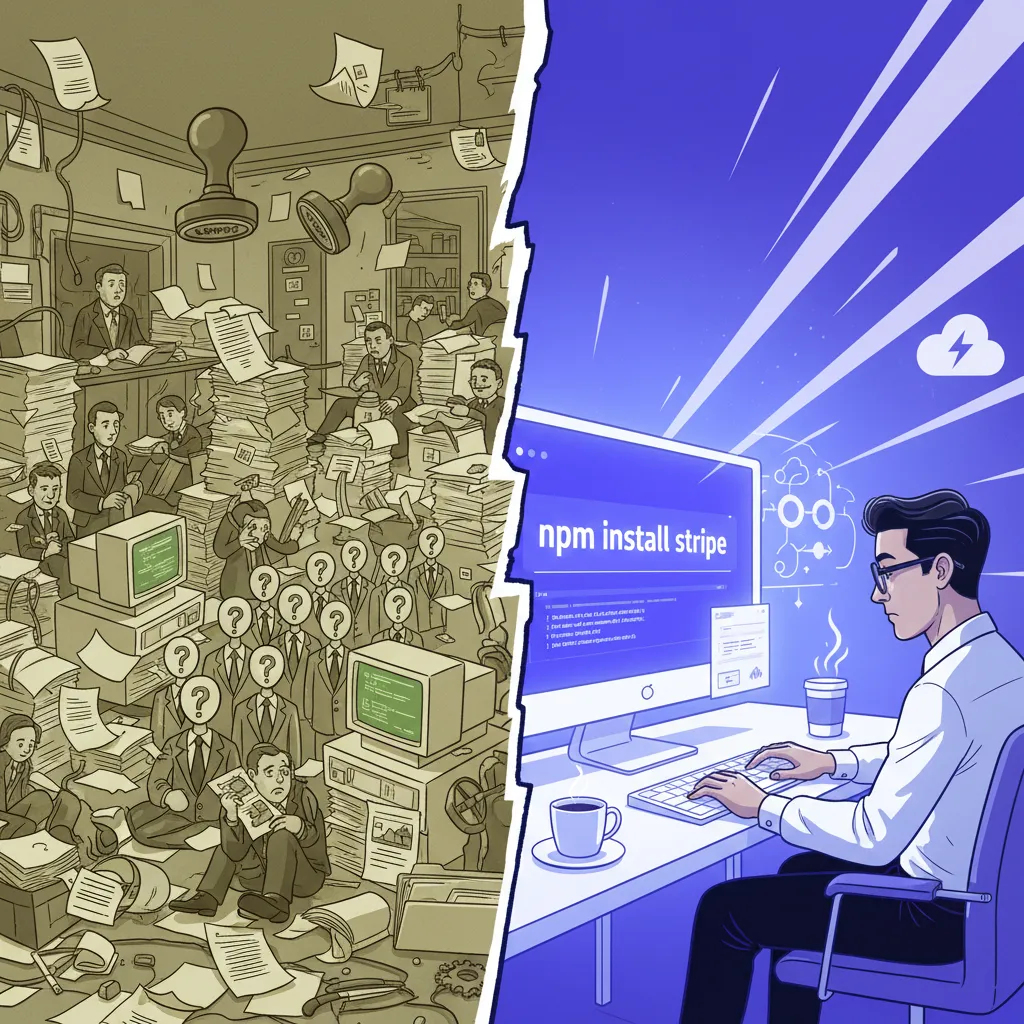 Payments used to be a mess to implement.
You wanted to start charging, so you called your bank, waited for somebody competent, received ugly documentation, and then created tension between product people who wanted money to come in and developers who knew the integration would be painful. The complexity was real and visible, and it was sitting right in front of the teams trying to move.
Stripe did not make payments simple. It made payment integration easier to adopt.
That is a much more important distinction.
The financial complexity was still there. The legal complexity was still there. The operational constraints were still there. What changed is that more of the mess was handled before it reached the people implementing the product. Better docs. Better interfaces. Better developer experience. Better clarity about what to do next.
That last point matters. The user is not always the final customer. Sometimes the user who determines success is the developer integrating the product. If the developer experience is miserable, the product experience is already broken before launch. The pain is just hidden in another room. That is why developer experience, or DX, is not a side concern for technical products. It is part of the product UX.
ChatGPT won with delivery, not just power
ChatGPT is the cleanest AI product UX example because it makes the adoption lesson impossible to ignore.
Yes, the underlying capability matters. But the product landed because the experience was obvious from the first second. You open it, you see a large input box, you type a request, and you get a response. No ugly setup. No technical ceremony. No need to understand the machinery first. That is the difference between an AI capability and an AI product people can actually adopt.
That sounds trivial until you compare it to what usually happens when a powerful technical capability is released. Too often, people get an API, a script, a weird interface, or a half-broken widget buried somewhere in a page. The capability exists, but adoption stalls because the path is annoying.
ChatGPT removed the first layer of friction.
Keep it simple. A simple need, a simple path, a simple interface. Not because the thing behind it is simple. Because the complexity has been handled before it reaches the person trying to use it.
Complexity never disappears, it moves
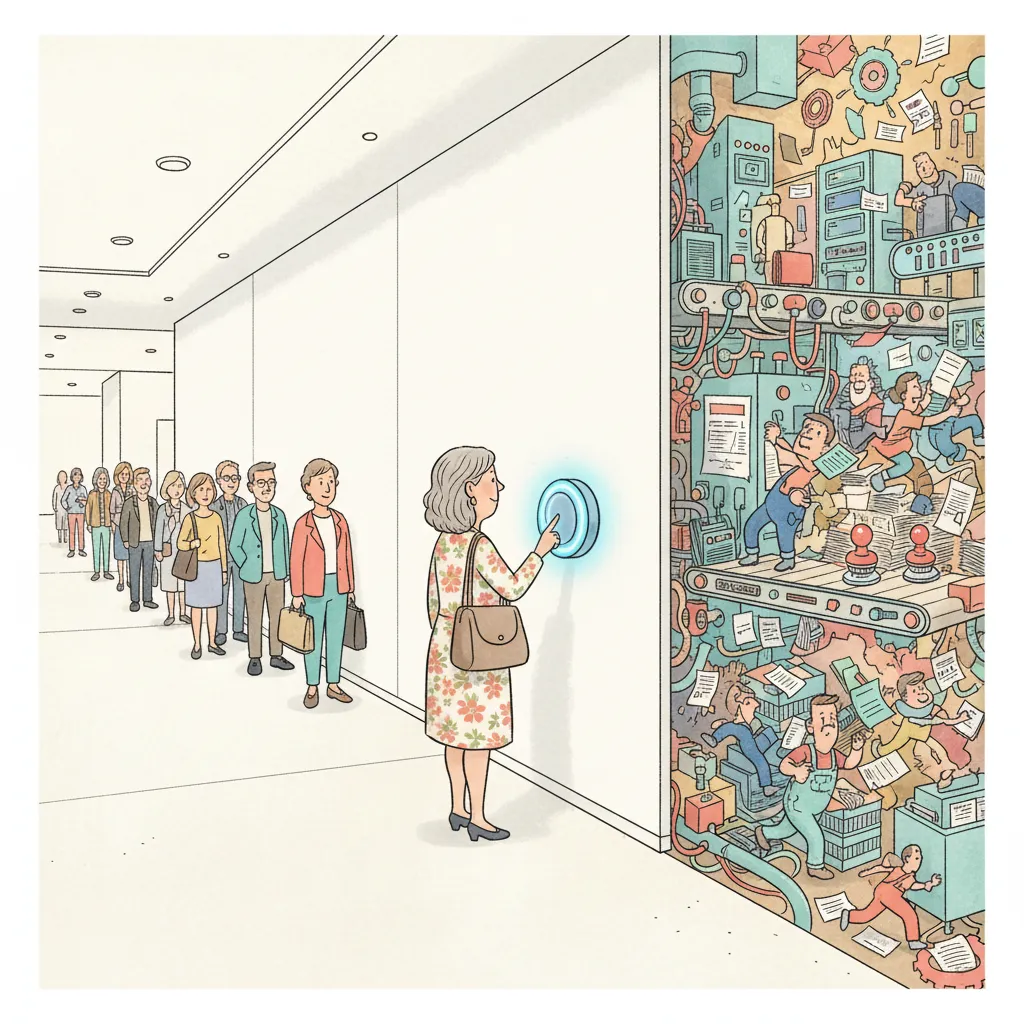 Compliance stays hard. Security stays hard. Payments stay hard. Operations stay hard. Real products still have to deal with reality.
The best products do not make that reality disappear. They decide where it should live.
ChatGPT is the extreme version of that contrast. Transformers and large language models are among the most complex technologies humans have built, but the interface is one of the simplest: a text box, a conversation, and an answer. The complexity is still there. It just does not sit in front of the user.
That is the actual product choice.
Do you absorb the complexity in engineering, defaults, docs, support, and design?
Or do you externalize it and let the user absorb the pain?
Once you see the pattern, you see it everywhere.
Stripe did it with payments. ChatGPT did it with AI. The same logic also explains why some developer tools become category standards: they do not invent the hard thing from nothing, they make hard things reachable.
That is what happened with Docker.
Docker proves that “already existed” is a weak critique
Docker is my favorite example of people missing the point while pretending to be smart.
The classic reaction was: containers already existed. True. Also irrelevant.
A thing can exist for ten years and still be inaccessible to most people. If the capability only really works for experts, or only inside heavy enterprise setups, or only with the help of one local wizard who knows how to make it behave, then from a product point of view it is still far from solved.
What Docker changed was not only the technology. It changed the distance between capability and use. That is the product UX lesson behind developer tools adoption.
The tool was simpler. The docs were more digestible. The first successful use happened faster. Suddenly normal developers could get an environment that looked much closer to production without needing an entire ritual around it.
That is what made it spread beyond experts.
Not novelty alone. Accessibility changed the adoption curve.
Product UX is not just interface
This is also why I do not like talking about product UX as if it only meant visual polish.
Interface matters, of course. But there is something bigger underneath it: ecosystem experience. Real user experience includes the whole path. How many problems does the user still have to solve manually? How many invisible gaps are they asked to bridge themselves? How coherent does the whole thing feel from one step to the next?
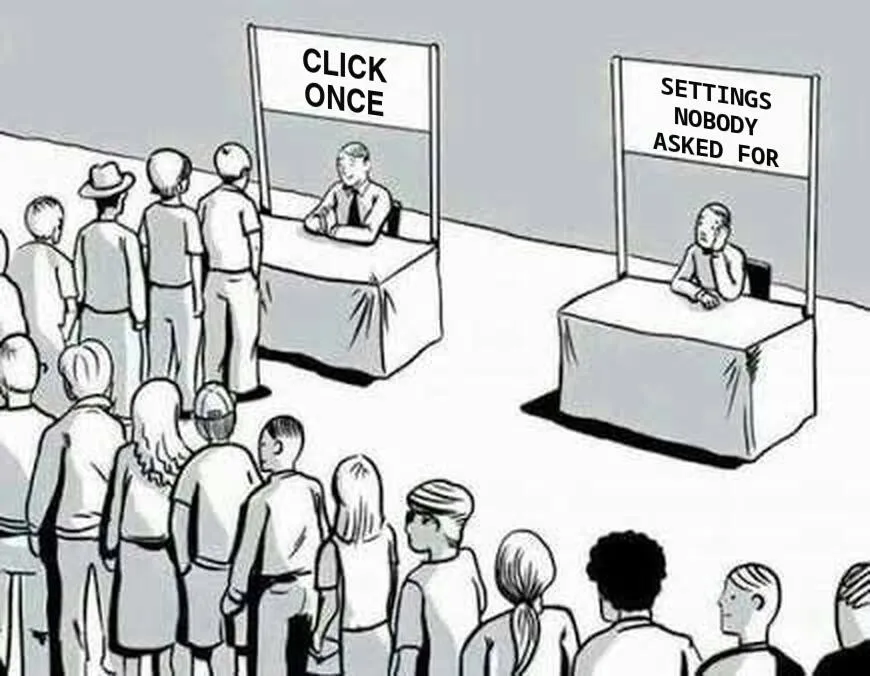 Users want fast-to-understand and easy-to-use solutions.
That is why consumer ecosystems can feel “better” even when the real explanation is not beauty, but continuity.
Users want fast-to-understand and easy-to-use solutions.
That is why consumer ecosystems can feel “better” even when the real explanation is not beauty, but continuity.
And that is also why a company can get one part very right and another part very wrong. You can make things feel smooth for mainstream users and still ship a developer tool that feels rigid, painful, and absurd. Xcode is the obvious example. Good product experience is never universal by magic.
It has to be built again and again, in each layer.
Good positioning cannot save a punishing product
Proton shows the opposite case.
You can be in the right market. You can stand for the right thing. You can even be early. None of that protects you if the product keeps punishing the user.
Security and privacy products make the problem even clearer. Security is hard. Of course it is. But the real question is not whether the underlying subject is complex. The real question is whether the product exposes that complexity in a way that makes people safer, or in a way that makes people more fragile.
That is why the password-recovery anecdote matters. If a user can lose everything from one mistake and the product still does not make that risk impossible to miss, then the problem is not only technical. It is product design. The company chose where the burden would sit, and it left too much of it with the user.
That is the danger for Proton, and for any product with strong positioning and weak experience. Someone else can come later with the same promise, package it better, and make the original version look archaic.
The product UX rule
A product does not win because it is more advanced on paper.
It wins because it solves a real problem, arrives when the market is ready, and gives people a path to value that feels simple enough to start. That is the product UX layer most technical teams underestimate.
That does not mean the work is simple. It means the work is yours.
Absorb the complexity in engineering, defaults, documentation, support, and design. Make the first experience clear. Make the next step obvious. Make the user feel rewarded for trying instead of punished for not already knowing.
And every time you are tempted to leave the painful part in front of the user because fixing it properly would take more work, remember this:
if you move the complexity to the user, you are doing a bad job.

Rudy Baer
Founder and CTO of
BearStudio,
Co-founder of
Fork it! Community! &
Peinture