AI is changing product design, but not the way people think
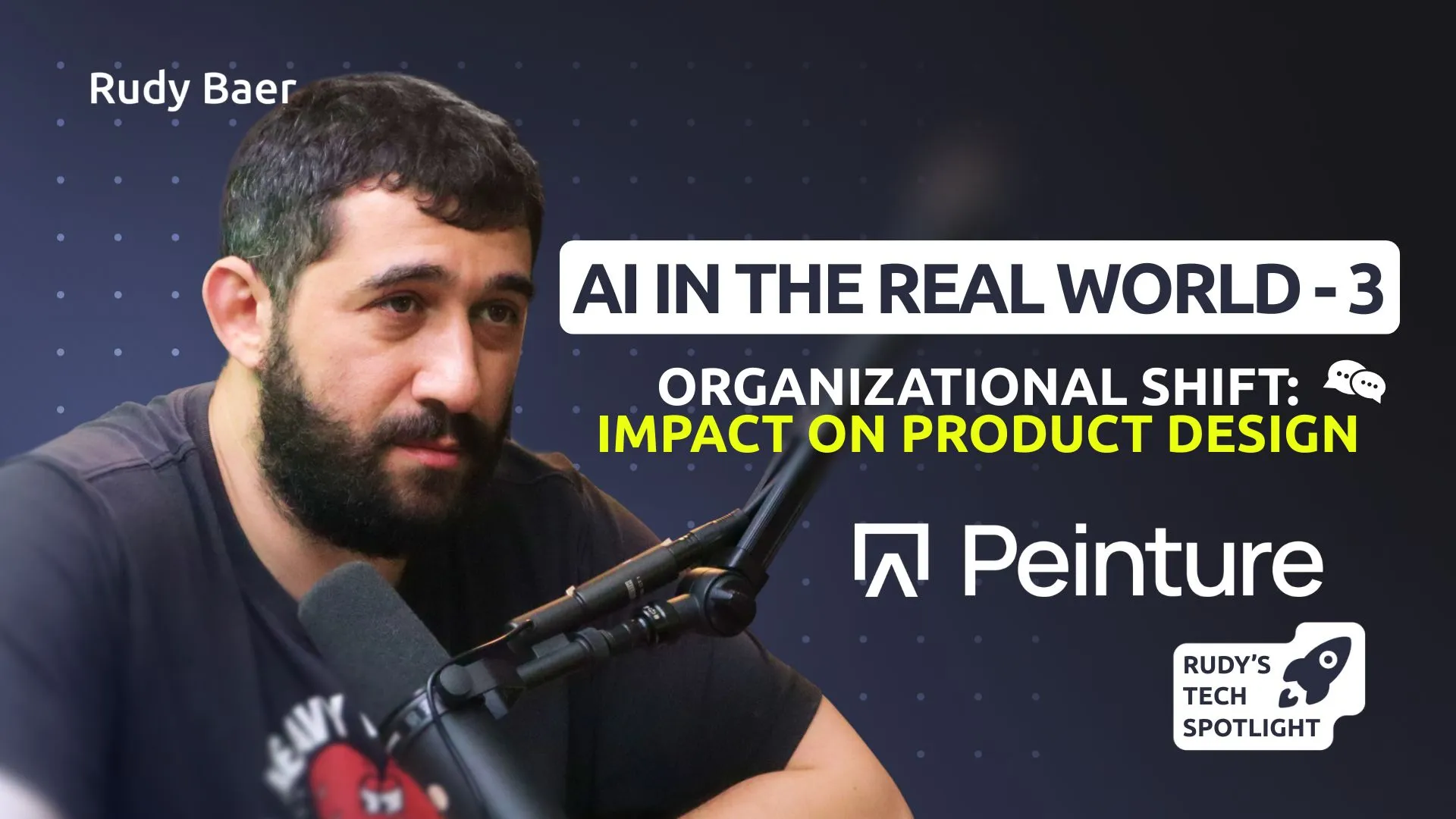
In my previous article about AI and software production cycles, I said AI would deeply change product design.
At the time, I thought the obvious impact would be interface generation: faster screens, faster prototypes, faster visual exploration.
I was wrong.
After spending months experimenting with AI-assisted workflows with designers, developers, product teams and business stakeholders, I’ve become convinced the real transformation has almost nothing to do with generating prettier screens faster.
The real shift is organizational: AI is changing the economics of clarification.
And I think most companies still do not realize what is happening.
Before going further, I should clarify something important: when I talk about “design” in this article, I’m not only talking about UI mockups or visual work.
I’m talking about the whole product conception layer between business intent and software implementation: how organizations transform messy human discussions, constraints, ideas and business needs into coherent software decisions.
And honestly, this layer is still far more artisanal than most people realize.
Product design was never really industrialized
Software engineering has standards: automation, collaborative tools, quality control, deployment processes and shared conventions.
The industry spent decades building systems to reduce chaos and synchronize teams around increasingly complex software.
But product conception?
Honestly, it is still surprisingly artisanal.
Most companies still rely on a mix of workshops, meetings, documents, Figma files, historical knowledge and vague human synchronization mechanisms held together by a few people who “understand how the product works”.
And this works… until scale appears. Or until AI accelerates everything…
The “design is creativity” myth
One of the biggest problems is that product design is still largely perceived as a creative discipline.
That perception mostly comes from the visible side of the job. Interfaces, branding, visual hierarchy and polished mockups are what people remember, because visibility is literally their function.
But this creates a dangerous confusion: people mistake the visible output for the actual work.
In real software products, especially existing ones, product design is rarely only about artistic expression. It is about framing decisions, organizing constraints, defining interactions, clarifying edge cases and making sure the product still behaves coherently once it meets reality.
At its core, it is about reducing ambiguity. About translating business constraints into coherent systems. About helping multiple people realize they were not talking about the same thing in the first place.
The mockup itself is almost secondary. The real value is the synchronization process behind it. And today, that synchronization layer is incredibly inefficient. A lot of companies are basically running million-euro products on tribal knowledge and vibes.
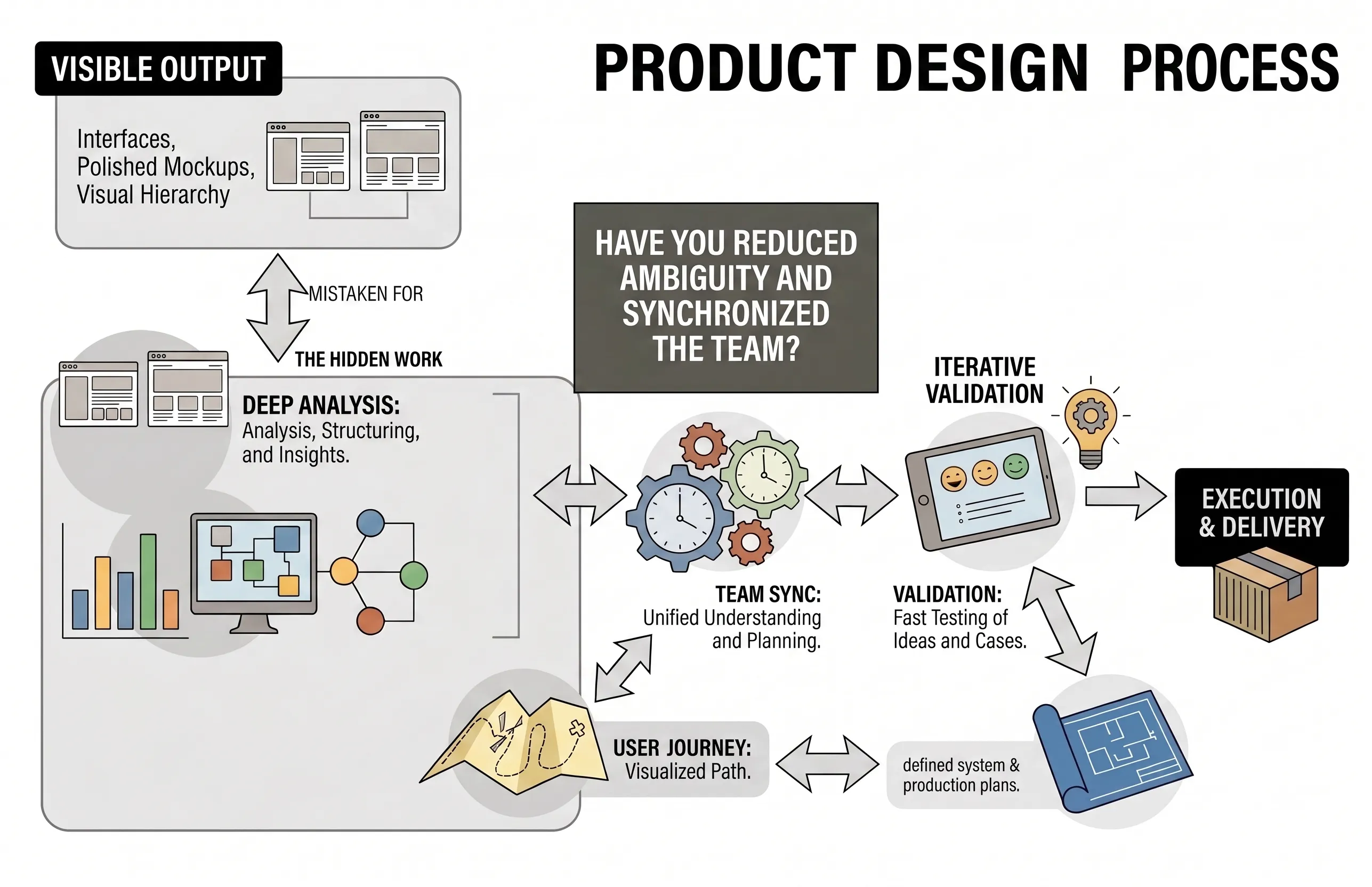 Behind the “creativity” wall: analysis, discussion, idea validation, and constant synchronization between clients and teams.
Existing products run on institutional memory
Most software products are not greenfield startups starting from a blank page.
They are old, evolving systems full of hidden business rules, legacy workflows, edge cases and technical compromises accumulated over years. In many organizations, product evolution depends less on formal processes than on a few humans carrying institutional knowledge inside their heads.
Usually, there is a PM, designer, developer or business expert who acts as the human API between teams.
The product works because this person remembers why things exist. This is not scalable. And AI is about to expose how fragile this model really is.
Because suddenly, the speed of execution is no longer hiding the organizational mess anymore.
AI changes the cost of feedback loops
For years, producing realistic interfaces and prototypes required time.
A business request had to pass through multiple translation layers before becoming something concrete enough for stakeholders to react to: Meeting. Notes. Wireframes. Mockups. Prototypes. Specs. Development. Reviews. Corrections.
Every layer introduced interpretation loss.
Every layer created opportunities for the same sentence: “No, that’s not what I meant.”
AI changes this dynamic because generating realistic interfaces, prototypes and even working applications is becoming dramatically cheaper. More importantly, it becomes dramatically cheaper to make ideas tangible.
Today, with the right tooling, you can show business teams a realistic version of a feature almost instantly. Not a vague wireframe requiring imagination. An actual interface. Something concrete enough to react to. And this changes everything. Because most misunderstandings survive only while discussions remain abstract.
The moment people see something tangible, the gaps appear immediately. Which is excellent news. Discovering you misunderstood the problem after ten minutes is infinitely cheaper than discovering it after three sprints and two passive aggressive meetings.
Here’s an AI-generated strip illustrating a typical modern meeting: a designer presents a proof-of-concept, and I respond with the classic “That’s not what I meant.” The designer quickly regenerates a version that matches my expectations within minutes, allowing us to rapidly agree on the project’s direction.
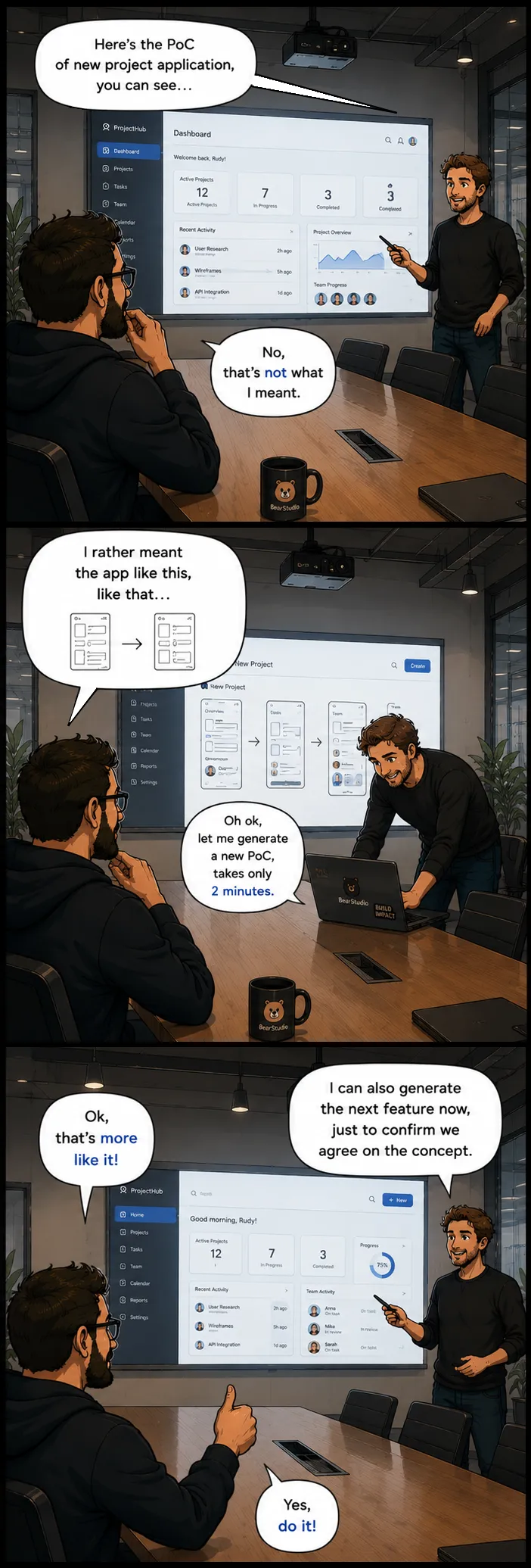 AI makes feedback loops dramatically cheaper. By turning ideas into realistic prototypes within minutes, teams can spot misunderstandings early, align faster, and iterate before costly development work begins.
Speed matters. A lot.
When the time required to generate interfaces, prototypes or even production-ready code collapses, entire categories of conversations suddenly become possible.
Teams can explore more ideas. Test more assumptions. Surface misunderstandings earlier. Show concrete things instead of debating abstractions for three meetings.
That matters enormously.
For years, a lot of companies accepted misunderstanding as operational overhead simply because reducing it was too expensive. Producing realistic prototypes, testing variations or validating assumptions required time, coordination and specialized work.
AI changes that equation completely. Now it becomes cheap to externalize ideas quickly. And once assumptions become visible, people can finally challenge them before the wrong thing gets built.
That is the real shift. Not “prompt to UI”, but “shared understanding before shared technical debt.”
The problem is not acceleration. The problem is uncoordinated acceleration.
Because if every team suddenly starts generating screens, flows, specs and code at machine speed without shared standards or orchestration, the result is not better products. It is faster confusion.
AI does not automatically reduce chaos. Without structure, it scales it. And honestly, I think this is where a lot of the industry is currently confused.
People focus on generation.
I think the much bigger problem is synchronization.
Product design needs its own CI/CD moment
Software engineering became scalable once it embraced continuous integration.
I think product conception is about to go through a similar transformation: not CI/CD for code, CI/CD for understanding.
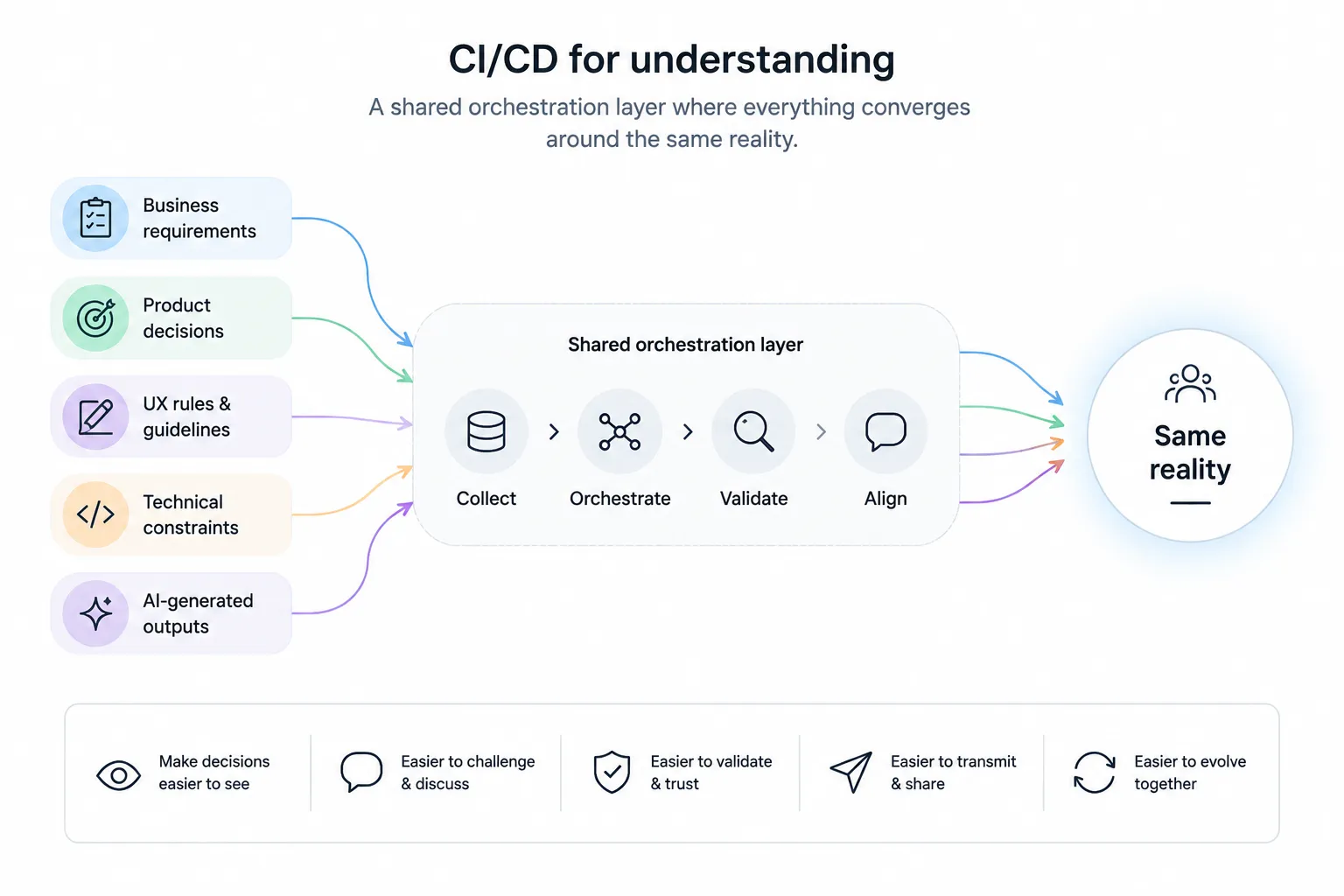
A shared orchestration layer where business requirements, product decisions, UX rules, technical constraints and AI-generated outputs all converge around the same reality.
To be clear, I do not think product decisions themselves should become rigid or standardized mechanically.
The goal is not to industrialize creativity.
The goal is to industrialize clarity.
To create systems where decisions become easier to make visible, challenge, validate, transmit and evolve collaboratively. Because today, most organizations do not really suffer from a lack of tools. They suffer from the cost of misunderstanding.
And AI suddenly makes this problem impossible to ignore because implementation itself is becoming cheaper.
The bottleneck is moving upward.
The difficult part is no longer only building software. The difficult part is figuring out what should exist before twenty people confidently build the wrong thing faster than ever before.
This is why we are building Peinture
At BearStudio, we’ve spent more than a decade designing and developing complex software products.
Over time, one thing became obvious:
Most teams do not lose time because they lack skills. They lose time trying to understand each other.
That observation became the foundation of Peinture.

Peinture is an AI-native orchestration platform for software product conception. Not another generic AI assistant. Not another “generate a screen from a prompt” demo made to farm likes on LinkedIn.
Peinture helps business, product, design and technical teams work from the same reality. It turns messy discussions into shared product decisions: clarified needs, prototypes, business rules, specifications and a common understanding of what should be built.
The goal is simple: help organizations move faster, with less friction and fewer misunderstandings.
Because the future challenge is not generating more interfaces. The future challenge is generating coherent decisions.
And honestly, I think a lot of the current AI tooling ecosystem is optimizing the wrong layer of the problem.
Want to request a demo of Peinture? Here’s the website: https://www.peinture.app/ give it a try!
Designers are not disappearing
I do not believe AI makes designers obsolete. But I do believe it changes what makes them valuable.
If the primary value of a designer is manually producing static mockups, then yes, AI will inevitably pressure that role. But strong designers were never valuable only because they could draw interfaces. They were valuable because they could structure complexity, challenge assumptions, maintain coherence and transform ambiguity into understandable systems.
Ironically, AI probably makes these skills even more important. Because when production becomes cheap, judgment becomes expensive. Everybody is obsessed with generating faster.
I think the real scarcity will become: people capable of deciding correctly in increasingly accelerated environments.
My bet on where the industry is going
I usually dislike making predictions because the tech industry already produces enough fake futurism without my help. But on this topic, I’m unusually convinced.
I genuinely believe the next major productivity shift in software will not primarily come from faster implementation. It will come from reducing the organizational cost of misunderstanding.
The bottleneck is moving upward.
The difficult part is no longer only writing software.
It is aligning humans, systems and AI agents around the same understanding of reality.
That is why I believe orchestration will become one of the most important layers of modern software organizations.
And honestly? I believe in this strongly enough that I’m literally betting my business on it.

Rudy Baer
Founder and CTO of
BearStudio,
Co-founder of
Fork it! Community! &
Peinture