Why is it still so hard to find good UX designers?
Simple answer: because we often look for them among graphic designers.
And the more I look back at our past hiring attempts, the more I think this is probably where the problem started.
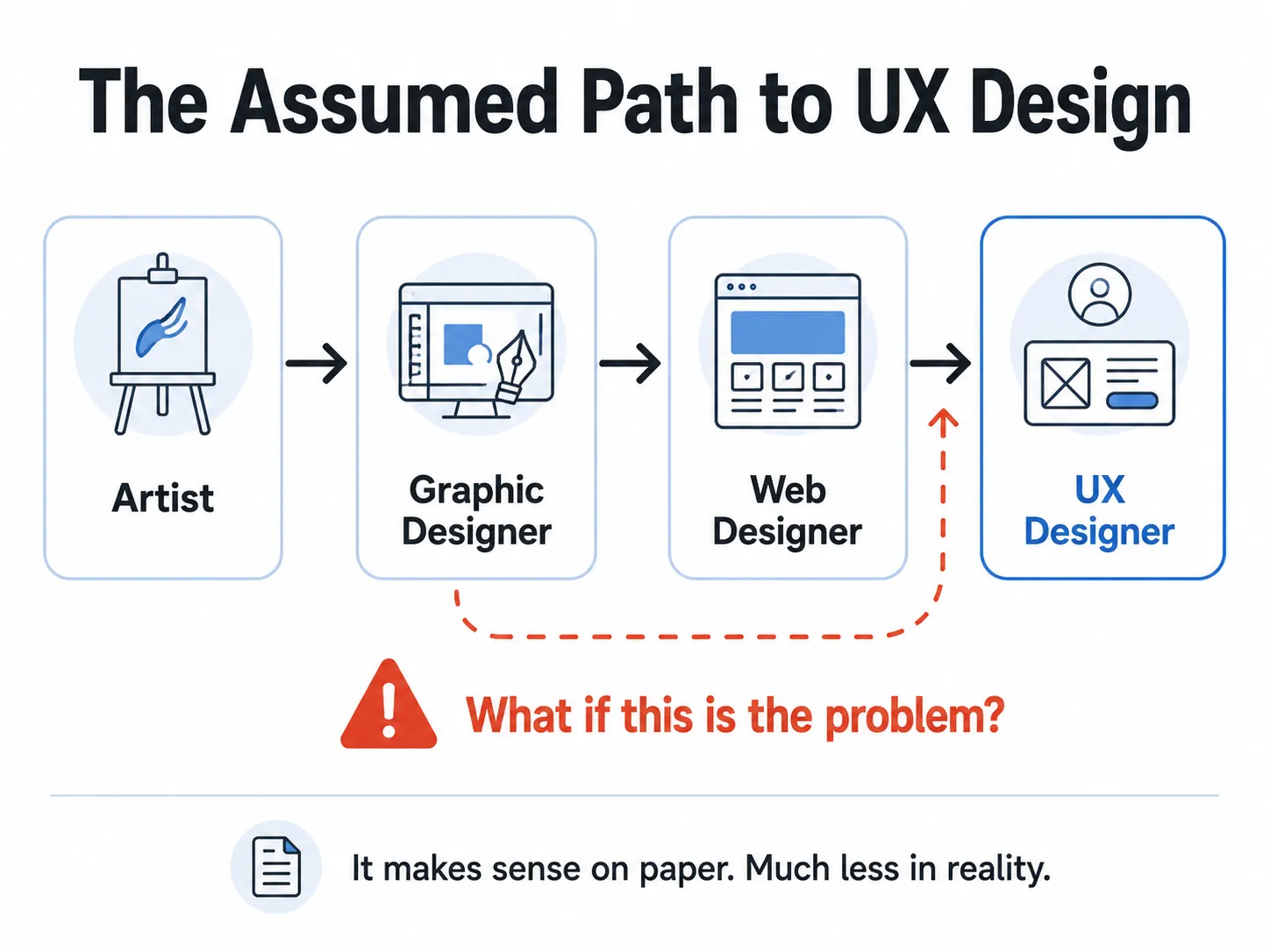
For a long time, we considered the natural path to UX design to be:
Artist → graphic designer → web designer → UX designer
On paper, it makes sense.
In reality, much less.
Because a good UX designer is not just someone who can design a beautiful interface. It is someone who can understand a need, share a vision, get a team aligned, and propose a solution that is efficient, usable, realistic, implementable, and compatible with the budget, technical constraints, deadlines, and the client’s level of maturity.
In other words: this is not a “creative job” in the traditional sense.
And that’s where we got it wrong.
The “creative profile” misunderstanding
When we recruit UX designers from a pool of highly visual profiles, we often end up with people who love making things look good. Which is obviously a quality. But it’s not the main point.
The main point is to move the project forward.
And that requires qualities that are not always found in traditional creative profiles.
On one side, you can find profiles with a strong desire for artistic direction, a very assertive personality, sometimes dangerously close to the cliché of the diva. They want to defend their vision, their aesthetics, their intention. That is interesting when you are looking for an art director. Much less when you need to align business stakeholders, a PM, developers, a budget, a deadline, and a real user problem.
On the other side, you can also find more reserved profiles, strong execution profiles, who do what they are asked without challenging too much. That can also be useful in some contexts. But it is not enough to do UX at the right level.
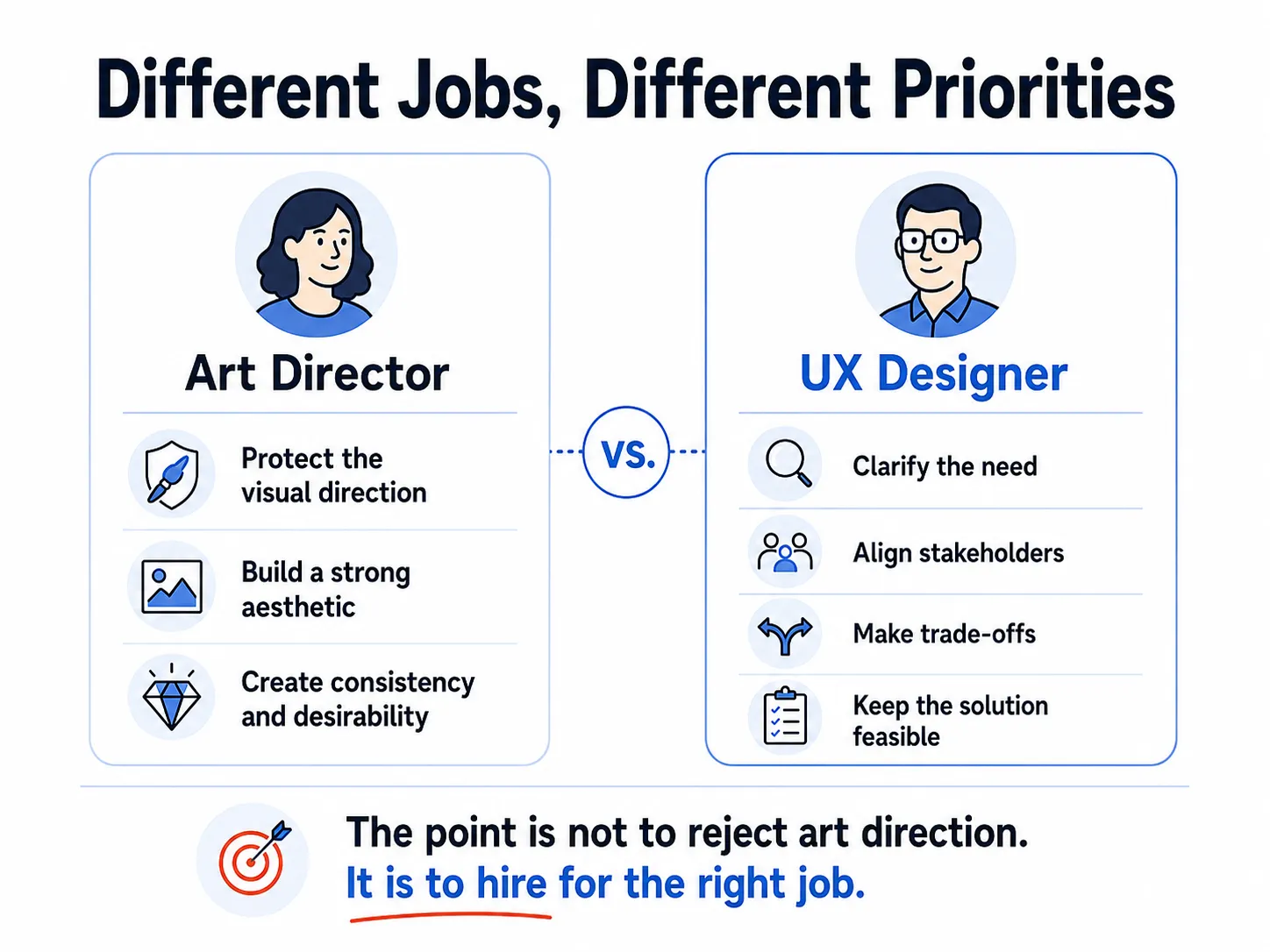
Because a good UX designer must know how to say no.
Not the offended artist’s “no”.
The useful “no”. The one that clarifies. The one that prevents the project from hitting a wall. The one that suggests a better option.
And above all, they must know how to do it without putting their ego at the center of the conversation.
Ten years looking for the right profile
At BearStudio, we searched for this profile for more than ten years.
We had many attempts. Many false starts. Very good people, sometimes very talented, but rarely fully aligned with what we were really expecting from the role.
We also had false positives. Ivan, for example, misled us for a long time on this topic, because he ticks a lot of boxes. He understands the product. He understands the constraints. He understands the business. He knows how to speak to clients. He knows how to challenge ideas. Except Ivan is not really a pure “classic” UX designer profile. And maybe that is precisely why it works.
We also had profiles who were very strong on pure UX skills, but for whom leadership, alignment, decision-making, and carrying a vision were more difficult.
And looking back, one signal should have made us realize this much earlier: Alexandra.
Alexandra originally had a background in architecture. Not in graphic design. And yet, on many topics, she had exactly the right reflexes: understanding the usage, structuring the problem, taking constraints into account, making decisions, and making things clear, feasible, and coherent.
It was not a coincidence.
You can watch a conference given by Alexandra “UX Design through the eyes of an architect” at Fork it! Rouen 2024 on YouTube.
Why did we miss it?
Because for a long time, the most visible part of the work was pushing pixels.
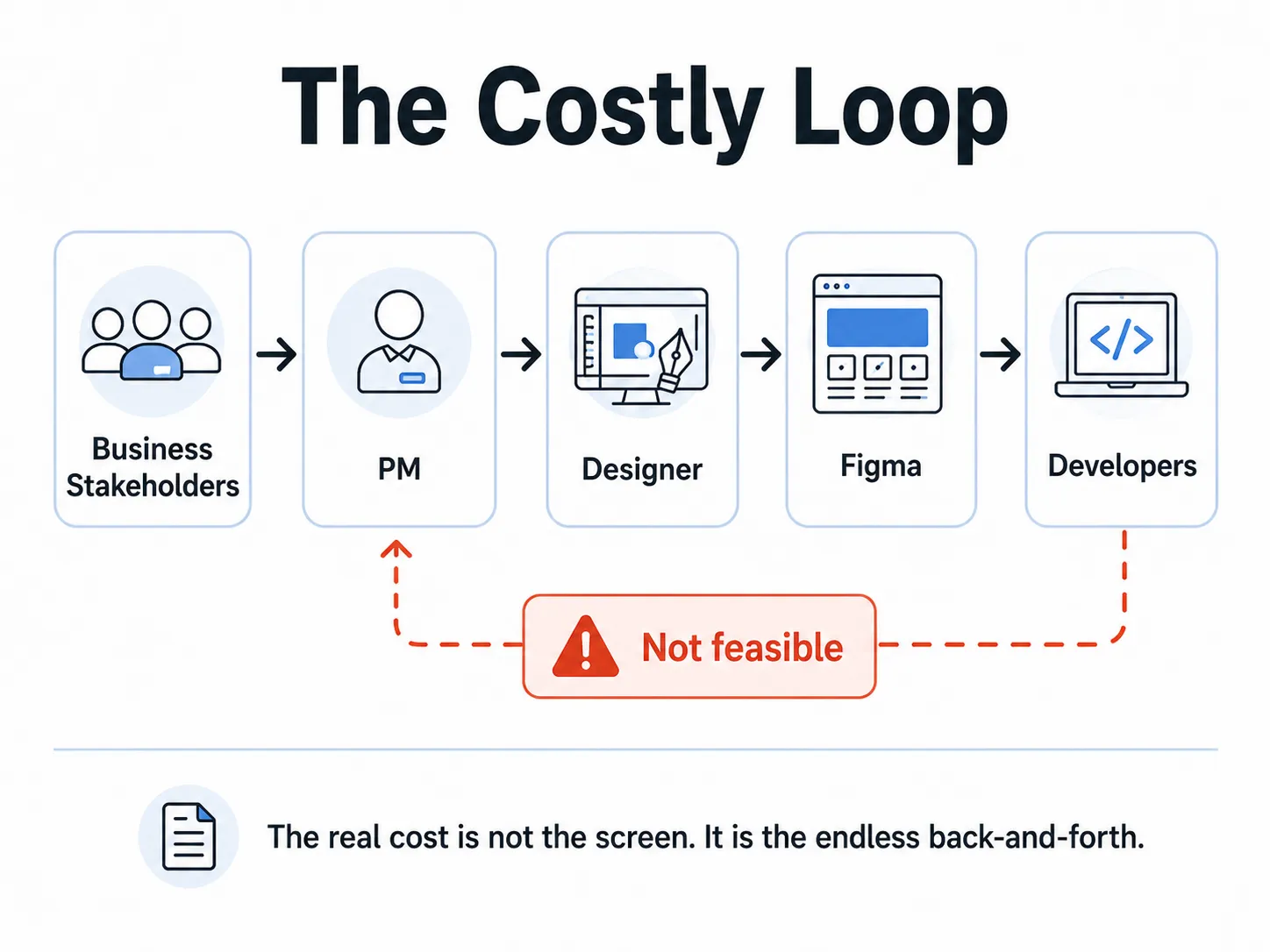
The standard process looked like this:
The PM collected the need from business stakeholders. Then they handed it over to the designer. The designer reproduced in Figma an interface that more or less already existed in everyone’s mind. Then we went back and forth until it looked right.
In that context, it was easy to believe that the core of the job was screen production.
So we recruited people who could produce screens.
Makes sense.
Except that was never really the point. It was just the most visible part.
And with AI, this becomes even more obvious.
AI removes the fake center of the job
AI is dramatically reducing the cost of producing and iterating on interfaces. Pixel pushing is going to be less and less central. Not completely useless, of course. We’ll still need taste, consistency, precision, and visual sensibility. But this is no longer where the main value will be created.
The real value will move even further upstream:
Clarifying the need.
Aligning business, product, and development teams.
Understanding what is feasible.
Identifying the real trade-offs.
Avoiding visually specified features that make no sense to build.
Making sure the interface serves the product instead of simply decorating the brief.
And to do that, we need profiles who can assert themselves without bringing misplaced ego. Someone who is not trying to impose a personal signature, but to move the project forward. Someone who understands that the best interface is not necessarily the prettiest one on Dribbble, but the one that solves the right problem, within the right constraints, with the right level of effort.
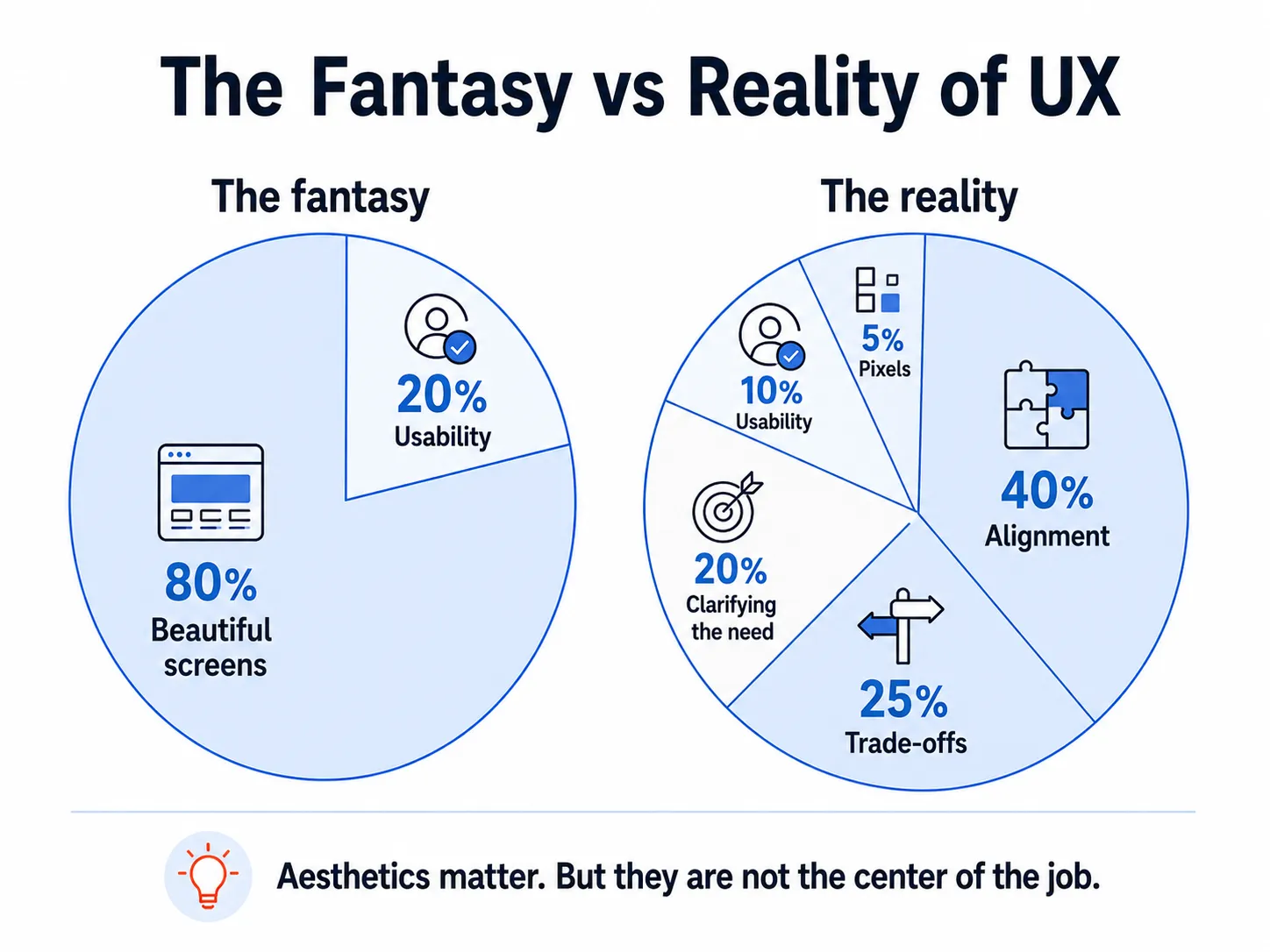
In fact, the more time passes, the more I think that, in many contexts, a good UX designer is 90% of a good PM and 10% of a usability expert.
Maybe a little more usability when you start from a blank page, obviously, 80% / 20% maybe. But in most projects, the point is not to invent a visual revolution. The point is to understand properly, frame the problem, make the right trade-offs, and communicate clearly.
Maybe we are recruiting for the wrong job
That is why I am starting to think that a UX position filled 100% by an artist profile has little chance of working in many organizations.
Not because artists or graphic designers have no value. They do.
But because we ask them to do a job that’s not exactly theirs.
In my opinion, it is sometimes more relevant to train a very good PM in web usability, or a good front-end lead developer in interface design, than to invest for years in a profile whose main skill is pushing pixels.
Because the real topic isn’t there anymore.
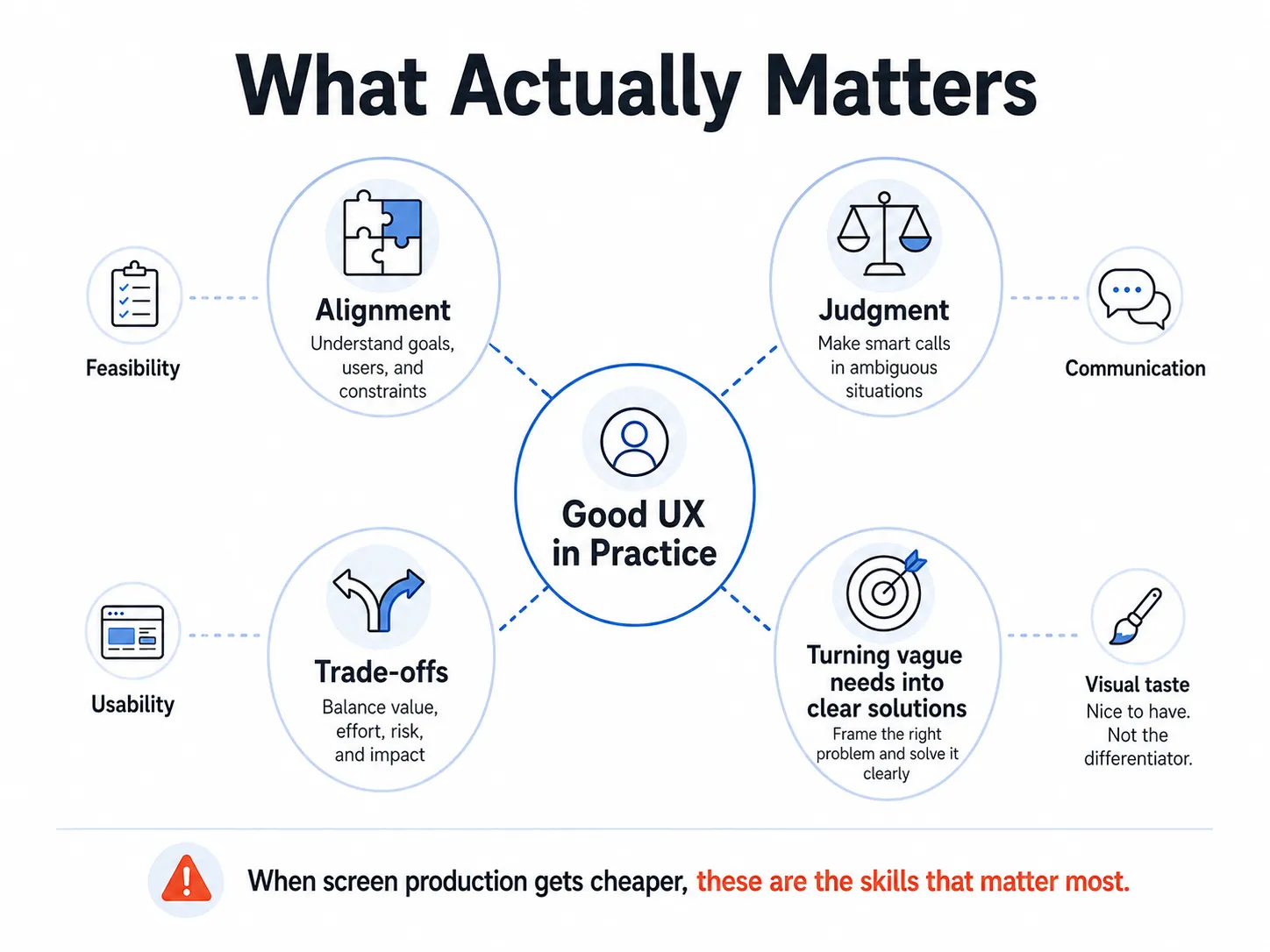
The real issue is alignment.
Judgment.
Ownership.
The ability to turn a vague need into a clear, useful, feasible, and maintainable solution.
And this is not a Figma problem.
It’s a posture problem.
Conclusion
I’m not saying that excellent UX designers can’t come from a graphic design background. They obviously can.
I am simply saying that the talent pool where we look for these profiles may not be the right one by default.
And I think AI will make this misunderstanding more and more visible. When producing screens becomes much cheaper, what remains is what truly matters: understand, make trade-offs, align people, decide.
So if you disagree, I sincerely invite you to come and prove me wrong.
But with arguments.

Rudy Baer
Founder and CTO of
BearStudio,
Co-founder of
Fork it! Community! &
Peinture